Error propagation
Overview
Three functions are used to study the error propagation from measured PV data to hydrogen based fuels techno-economic modeling:
solve_optiplant()
calculate_all_LCOF_diff()
generate_LCOF_diff_plot()
Techno-economic assessment model
The function solve_optiplant() is used to perform an optimization of investments and operation for a hydrogen based fuel production system.
More details about the model can be found in this article and repository.
Parameters
Name |
Type |
Description |
|---|---|---|
data_units |
pandas.DataFrame |
Techno-economic parameters for all system units. |
PV_profile |
pandas.DataFrame |
Hourly renewable generation profile. |
H2_end_user_min_load |
float |
Minimum H₂ end-user load as a fraction of capacity. |
solver_name |
str |
LP solver name (e.g., “GUROBI_CMD” or “PULP_CBC_CMD”). |
Returns
Return |
Type |
Description |
|---|---|---|
fuel_cost |
float |
Fuel production cost (EUR/t). |
df_results |
pandas.DataFrame |
Summary of techno-economic results. |
df_flows |
pandas.DataFrame |
Hourly flow and electricity data. |
Notes
Explicitly models storage, demand, and power balances.
Includes investment annuities and maintenance periods.
Uses PuLP for linear programming.
Example
(The file PV_profile.csv should be created by the user)
import pandas as pd
from simeasren import solve_optiplant

data_units = pd.read_csv("Techno_eco_data_NH3.csv")
pv_profile = pd.read_csv("PV_profile.csv")

fuel_cost, df_results, df_flows = solve_optiplant(
    data_units=data_units,
    PV_profile=pv_profile,
    H2_end_user_min_load=0.3,
    solver_name="GUROBI_CMD"
)
print(f"Fuel cost: {fuel_cost:.2f} EUR/t")
Calculate LCOF differences
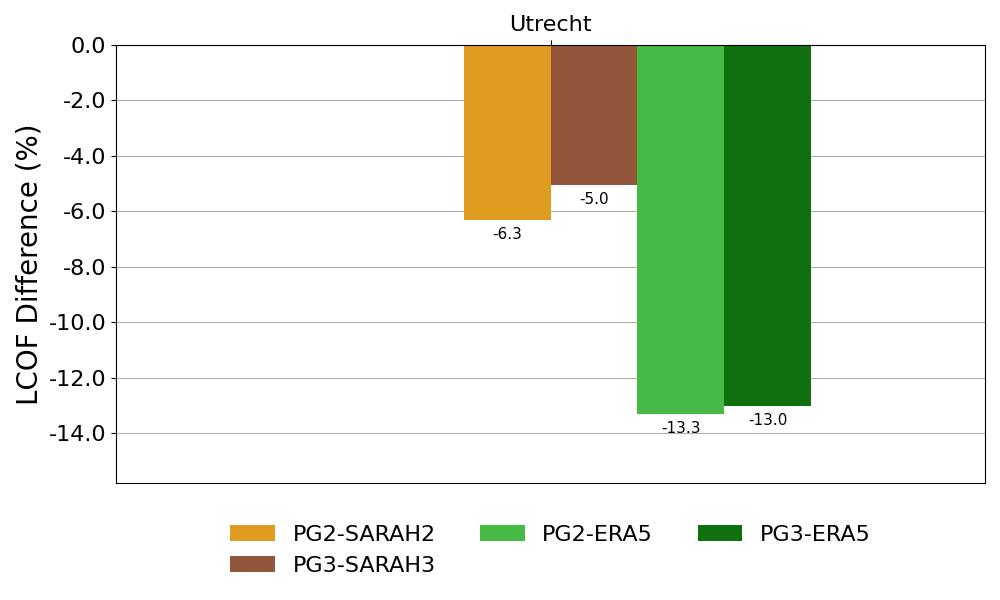
calculate_all_LCOF_diff() calculates and compares Levelized Cost of Fuel (LCOF) differences between measured and simulated renewable profiles for all the simulated tools running the “OptiPlant” tool for each profile.
Parameters
Name |
Type |
Description |
|---|---|---|
data_sim_meas |
pandas.DataFrame |
Combined measured and simulated data. |
location_name |
str |
Location to analyze. |
H2_end_user_min_load |
float |
Minimum load for H₂ end-user. |
solver_name |
str |
LP solver name. |
technoeco_file_name |
str |
Techno-economic data file (default: “Techno_eco_data_NH3”). |
Returns List of dictionaries with:
"Location"— Location analyzed."Tool"— Simulation tool name."LCOF Difference (%)"— Percentage deviation vs. measured data.
The results of the optimization (hourly optimal profiles, system sizing and costs) are saved as csv file in the results/location/Techno-eco assessment results folder for each PV power profile.
Example
from simeasren import calculate_all_LCOF_diff, prepare_pv_data_for_plots

data_sim_meas, _, _ = prepare_pv_data_for_plots("Utrecht", "2017")
results = calculate_all_LCOF_diff(
    data_sim_meas=data_sim_meas,
    location_name="Utrecht",
    H2_end_user_min_load=0.3,
    solver_name="GUROBI_CMD"
)
print(results[0])
Plot LCOF differences
generate_LCOF_diff_plot() Generates a bar plot comparing LCOF differences between measured and simulated datasets across tools.
Parameters
Name |
Type |
Description |
|---|---|---|
LCOF_diff_results |
list[dict] |
Output from |
location_name |
str |
Location analyzed. |
year |
str |
Year label for the plot. |
H2_end_user_min_load |
float |
Hydrogen end-user load constraint. |
output_root |
str |
Directory to save the plot (default: “results”). |
Returns None (saves plot directly).
Example
from simeasren import generate_LCOF_diff_plot, calculate_all_LCOF_diff, prepare_pv_data_for_plots

data_sim_meas, _, _ = prepare_pv_data_for_plots("Utrecht", "2017")
results = calculate_all_LCOF_diff(data_sim_meas, "Utrecht", 0.3, "GUROBI_CMD")

generate_LCOF_diff_plot(
    LCOF_diff_results=results,
    location_name="Utrecht",
    year="2017",
    H2_end_user_min_load=0.3
)